Performance duration
ca. 30’
Premiere
This is an unpremiered work.
Year of composition
2026
Instrumentation
A.Fl. (also Fl.), Ob., Cl., B.Cl., Bsn. – Hn., Tpt., Trb., B.Trb., Tuba – 2 Perc., Pf. – Strings (2.2.2.2.2)
Score (sample)
Program note (english version)
Background
Kimigayo (“His Majesty’s Reign”) is Japan’s national anthem. Its current melody was adopted in 1880, commonly attributed to court musician Hiromori Hayashi, and later arranged/harmonized by Franz Eckert. It served as a sonic emblem of the Empire of Japan throughout its era of imperial expansion and colonial rule—a period that brought immense suffering to the peoples of Ainu Mosir (traditional Ainu territory/Hokkaido), Ryukyu, Korea, China, Taiwan, and other regions across Asia and the Pacific.
After Japan’s defeat in 1945, the anthem was retained. In contrast to postwar Germany’s wide-ranging processes of reckoning and symbolic renegotiation, Japan’s public confrontation with the ideological apparatus of empire has often been criticized as partial and incomplete. Kimigayo remained in use, and in 1999 it was formally designated by law as the national anthem.
In contemporary Japanese society, the historical weight of “Kimigayo”—its entanglement with militarism, imperialism, colonialism, and war crimes—has largely faded from public consciousness. What was once a symbol of empire has been domesticated into a matter of etiquette. In January 2026, a Japanese Communist Party (JCP) prefectural assembly member remained seated during the singing of the national anthem at a municipal ceremonial event. Images of her were taken by someone associated with the councilor and later posted on X by the councilor, triggering a wave of online condemnation. After the post circulated, her act was framed by some as a breach of “manners” rather than as a matter of conscience; according to press reports, this was followed by in-person stalking/obstruction during her street campaigning and a surge of threats. The incident exemplifies a broader pattern: political dissent is often not debated on its merits but dismissed as a violation of social decorum.
This forgetting is sustained by the texture of daily life. Many people in Japan are absorbed in labor—working to live—with little time or energy for political engagement. This is not mere apathy, but a structural condition: people expend enormous energy simply maintaining their lives, and that energy, precisely because it is fragmented across millions of individuals, rarely coalesces into political force. The result is a society that continues to function, and maintains an appearance of prosperity, while historical accountability remains unaddressed—apologies and reparations remain inadequate, and ongoing injustices go unacknowledged. Even in elections, one of the means of political decision-making, economic concerns dominate, and these unresolved issues never become a focal point of debate.
This condition is reflected in the musical material. Dynamics are kept fundamentally fixed, and each part remains within a constant dynamic band (most parts are always forte, while the brass (except horn) and timpani are always mezzo-forte). Energy is constantly expended, yet because it is dispersed across fragmented gestures, it never accumulates into a coherent statement.
Listening Guide
In listening, the Kimigayo melody is not “sung” directly. Instead, pitch-name fragments (C, D, E…) assigned to each beat are handed from one instrument to another, emerging as though residues of sound stripped of meaning were piling up.
The tempo is fixed at ♩=70, following an early published version of Kimigayo.
The instrumental groups shift only gradually from section to section, and the set of available pitch classes expands and contracts; as a result, the color of the sonority changes very slowly. Yet because tempo, beat, and dynamics are fixed, that change may feel as though “nothing is happening.”
If the ear begins to acclimate, that acclimation—assimilation itself—is part of the piece. As the work proceeds, successive notes in the same instrument and sustained repetitions of the same pitch begin to appear, gradually increasing the time in which the same sound and the same instrument stay in place; the beat continues, but handoffs and switches diminish. That sensation begins to surface as a premonition of ritual stiffness. Settling into comfort stands back-to-back with forgetting meaning itself—the work takes up that ambiguity from within sound itself.
As a composer born and raised in Japan, holding a position within the country’s ethnic and social majority, I write this piece as an act of self-critique—questioning the historical responsibility of the society to which I belong, rather than speaking for those who suffered under its imperial rule.
Pitch System
This work is based on the melody of Kimigayo (Figure 1):
D C D E G E D E G A G A D B A G E G A D C D E G A G E G D A C D C D A G A G E D
The melody is processed through the following system:
- When the melody moves to a pitch not yet present in the current set, that pitch is added.
- When the melody moves to a pitch already present in the current set, the process shifts to a reduction phase, where the oldest pitch is removed step-by-step until only one remains. Then the next pitch is added.
Through this process, the set of available pitch classes changes in 76 stages (see Table 1).
Instrument Sections
The work is divided into 31 sections with varying instrumentation:
- Sections 1–13: 10 instruments, with 1 instrument exchanged per section
- Sections 14–21: 11 instruments, with 2 instruments exchanged per section
- Sections 22–26: 12 instruments, with 3 instruments exchanged per section
- Sections 27–29: 13 instruments, with 4 instruments exchanged per section
- Section 30: 14 instruments
- Section 31: 18 instruments (tutti)
At the boundaries between groups, one fewer instrument is removed than added, increasing the total. See Table 2.
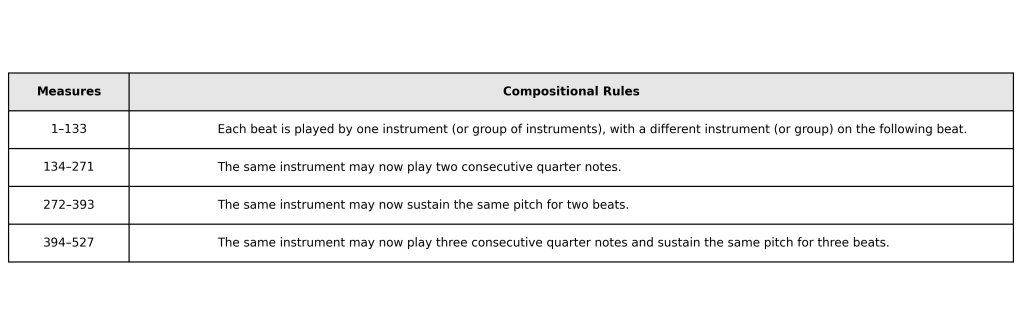
Compositional Rules
The compositional rules gradually loosen over the course of the work. See Table 3.
Figure 1
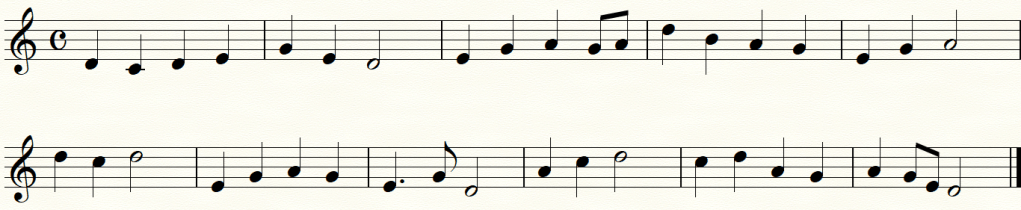
Table 1
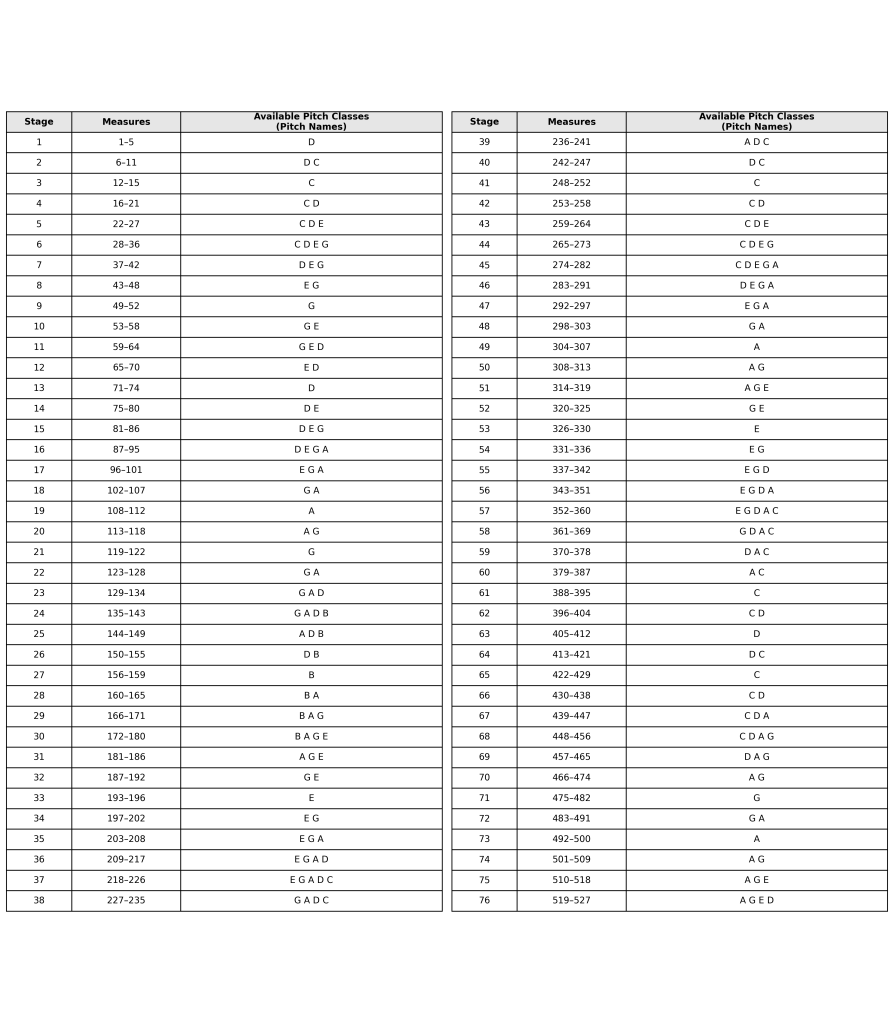
Table 2
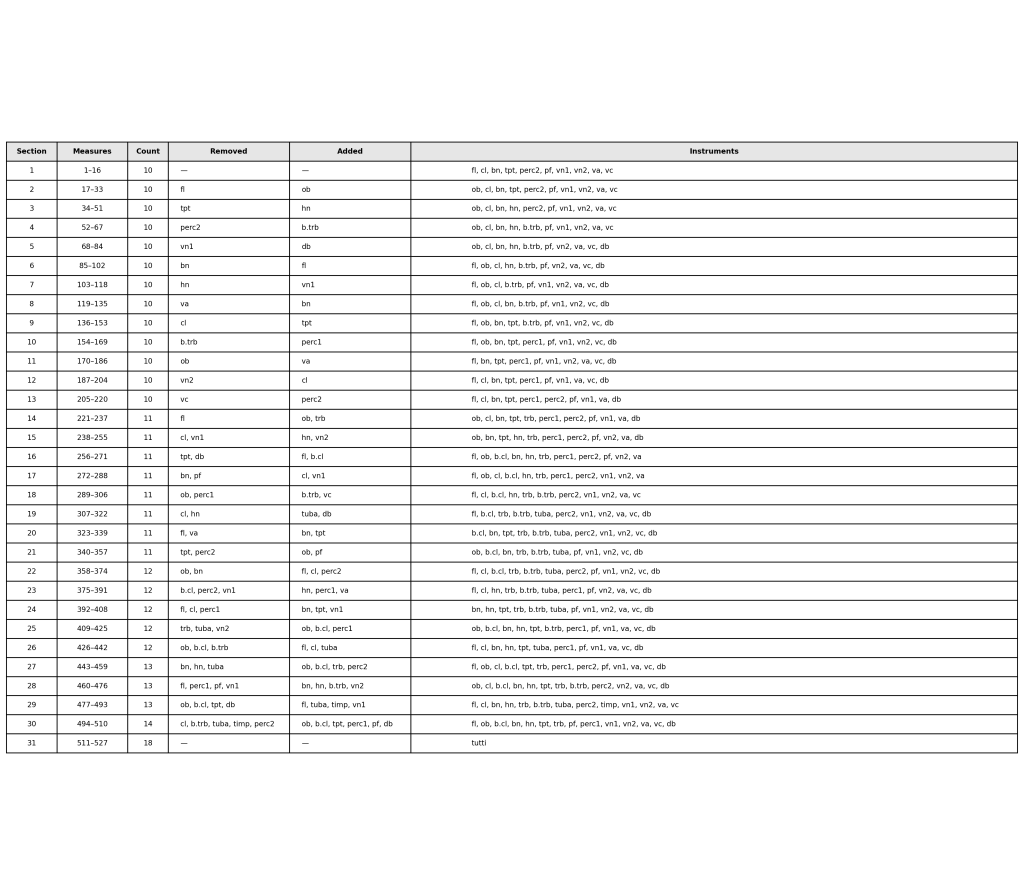
Table 3
 Takahiro Kuroda