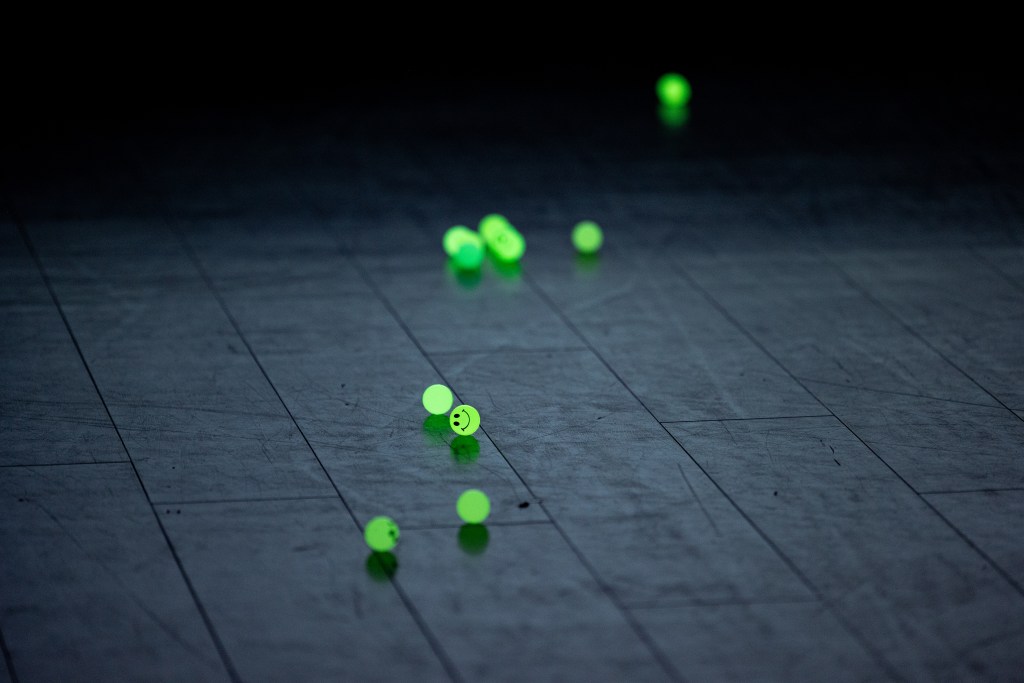
撮影:山田サトシ © 2025(Photo by YAMADA Satoshi)
Performance duration
ca. 40’
Premiere
演奏家を介さない演奏会 vol. 2
July 19, 2025, Tokyo, Shinjuku Ganka Garou Space Chika
Kiyoe Koiiduka, Actor; Maki Sakurai, Actor; Takahiro Kuroda, Video Operator; Ten Goto, Special Thanks
Year of composition
2025
Instrumentation
2 actors and video
1. はじめに
2. コンセプトの起点
3. 作品の構造について
1. 俳優の台詞
2. 映像
1. 映像の2種類のレイヤーについて
2. 1つ目のレイヤーの映像の種類と意図
3. 自身の立場性について
4. 2つ目のレイヤーの映像について
3. スーパーボールを用いた行為
4. 終わりに
5. 注釈
6. 補遺
1. 映像について
2. 壁・障壁、距離感についての補足——撮影映像を通して
3. 数字の台詞について
4. 詩について
5. 「遠心的」かつ「求心的」な循環
6. 作品化できなかったことへの反省点

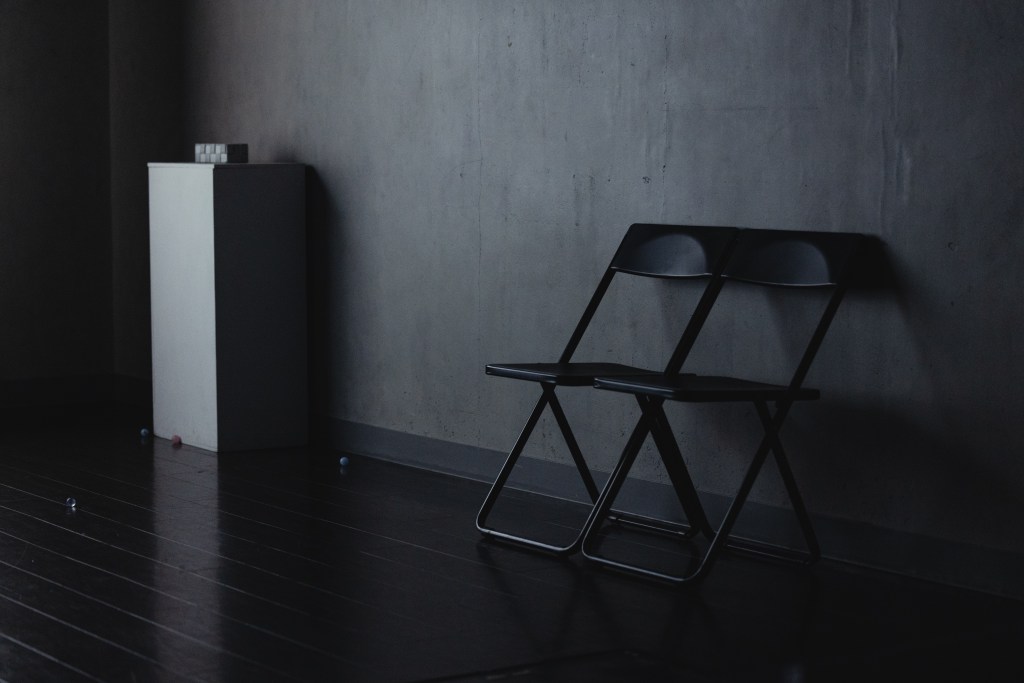
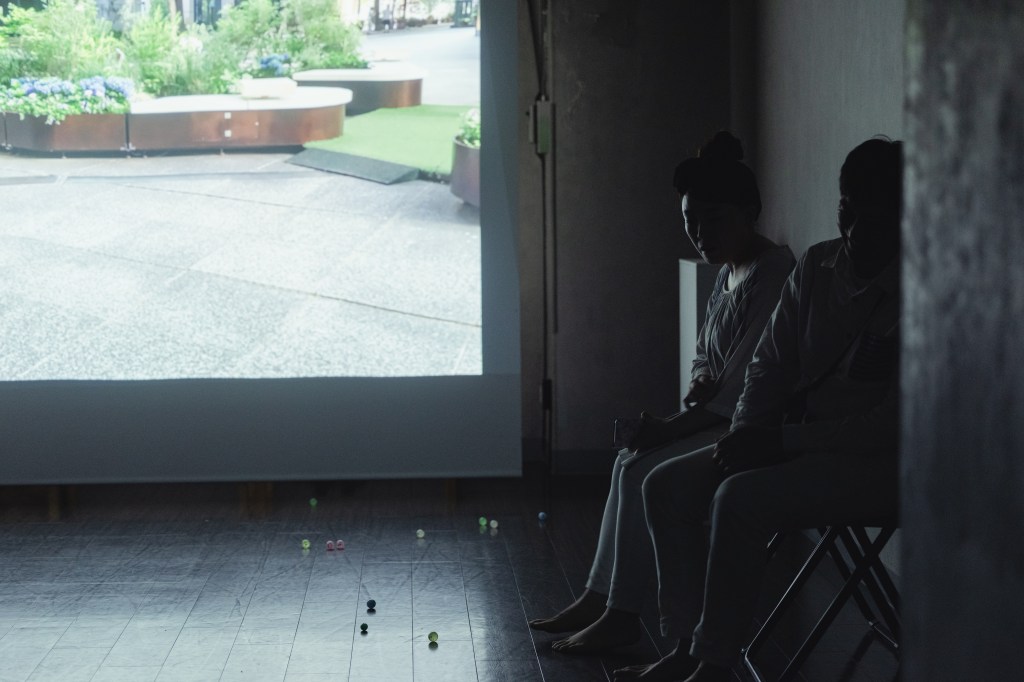


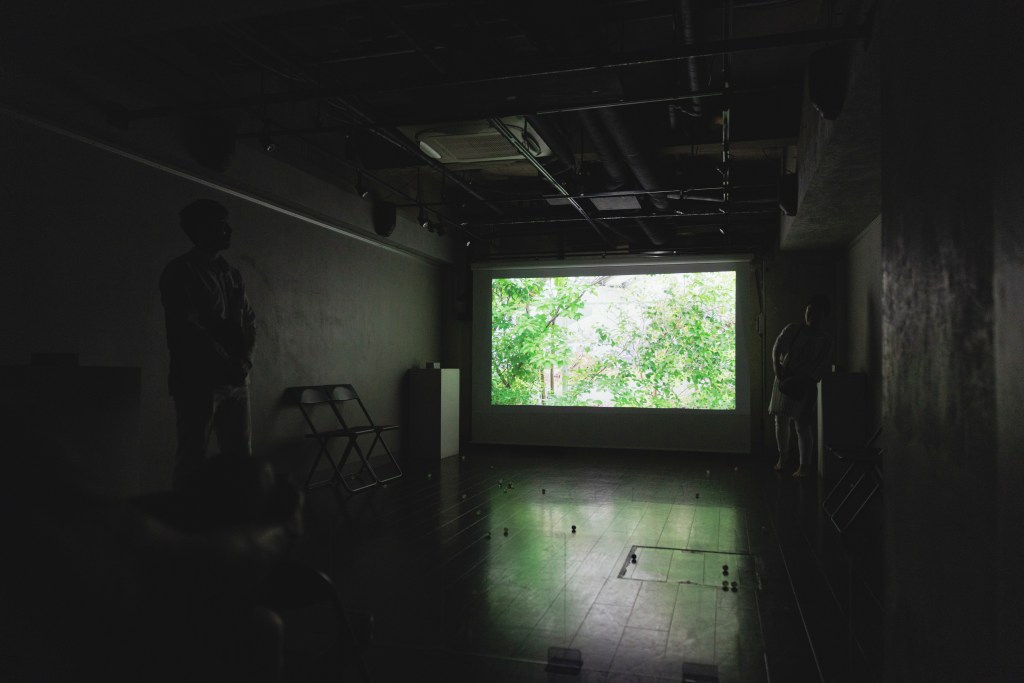
撮影:山田サトシ © 2025(Photo by YAMADA Satoshi)
はじめに
この作品を制作するうえで自分の持つ複数の属性と、目に見える/ない壁・障壁や距離感について考えていました。私という個人としての視点と経験、そしてそれらに加えて複数性という概念がこの作品のベースとなっていると言えるでしょう。
コンセプトの起点
作品のコンセプトを考えるうえで、ジャマイカの作家・詩人・研究者であるパメラ・モーデカイ(Pamela Mordecai)の、デレック・ウォルコット(Derek Walcott)の自伝的長詩『Another Life』を分析した、1987年発表の文学批評論文”A Crystal of Ambiguities: Metaphors for Creativity and the Art of Writing in Derek Walcott’s Another Life”において提示された、「プリズム的 -意識、 -ヴィジョン」(prismatic –consciousness, -vision)という彼女独自の概念を知ったことが起点となっています。この概念は「経験を時として解決されない複数性の中で知覚し解釈する傾向」として定義され、カリブ海地域の人々の特有の認知様式を表現しています。そして:
・論理的・線形的な認識方法とは異なる
・弁証法的でもない
・多面性と包摂性を併せ持つ知覚のあり方
を特徴とします。これは、アフリカから奴隷として連行された人々とその子孫が、強制された支配者文化と言語を受容しつつも、自らの言語・習慣・信仰を守り、混交(クレオライゼーション*)を通じて新たな共同体とアイデンティティを構築してきた歴史的背景に根ざしています。カリブ海文学・思想研究者の中村達は、その著書『私が諸島である カリブ海思想入門』(2023年、書肆侃侃房)の中で、「カリブ海における異なった文化的、人種的背景を持った人々が、クレオライゼーションの過程で互いに出会う中でその衝撃を耐え、新しい共同体へと自分たちを変えてゆくことのできる多彩な意識である。」としてこの概念を解説しています。
私は日本で生まれ育ったゆえに、カリブ海の島々に住む人々の経験を完璧に理解することは不可能ですし、カリブ海文学とポストコロニアリズムに基づく彼女のこの概念をそのまま用いることはできません。しかし、この概念は自分が恐らく無意識に感じていた経験と響き合うものがありました。これに触れたことで自分の経験や立ち位置についての認識の仕方がリビルドされた実感があります。そこから、今回の作品のコンセプトが形作られていきました。この概念を私自身の経験や持っている複数の属性に重ね合わせることで表現を模索します。本作品はそのオリジナルの思想に敬意を払い、その政治的・文化的背景を軽視しないことを前提にしています。
作品の構造について
作品内にはレイヤーとして以下の3つがあります:
・俳優の台詞(この中にも2種類のレイヤーがあります)
・映像(この中にも2種類のレイヤーがあります)
・スーパーボール(蓄光で光るものと、通常の光らないもの)を用いた行為
俳優の台詞
俳優の台詞のうち、1つ目のレイヤーは私のニューロダイバージェントの人(脳や神経のはたらき方が、社会における「ふつう」の基準、規範から外れたかたちの人)としての経験によるものです。俳優の一方はニューロティピカルの人(脳や神経のはたらき方が、社会における「ふつう」の基準、規範の中におさまっている人)で、もう一方は私に近いニューロダイバージェントの人です。その役はシーンによって入れ替わります。昔の私は話すことが苦手で(特に雑談)、相手に何を話しかければいいのかがわからない、相手の問いかけにもうまく答えられるものもあれば、答えられないものもありました(うまく答えられない方が多かったです)(現在は昔と比べるとましになったと認識しています)。そのような会話の短い断片的なシーンが延々と連続していきます。なお、これは自分のニューロダイバージェンス**の持つ1つの側面で、勿論他の側面もあります。私自身はAS(D)ですが、これはあくまで私自身のことや経験によるものなので、AS(D)の人がこうである、またすべてのニューロダイバージェントの人がこうであると一般化しないでください。
台詞の2つ目のレイヤーは数字です。詳細は補遺に記述します。
映像
映像の2種類のレイヤーについて
2種類ある映像のレイヤーのうち、1つ目のレイヤーの映像が投影されている時は、上記の1つ目のレイヤーの俳優の台詞が発せられます。2つ目のレイヤーの映像が投影されている時は、2つ目のレイヤーの台詞が発せられ、加えて、スーパーボールを用いた行為も行われます。
1つ目のレイヤーの映像の種類と意図
1つ目のレイヤーの映像は主に壁やフェンス、川を映したものが多いですが、それを映していないものも含めて映像にはマイノリティの属性としての私から感じるマジョリティへの壁や距離感を表すものと、日本におけるマイノリティ・周縁化された側の見えている・感じている、私が持つマジョリティの属性への壁・障壁や距離感を表すものがあります。目に見えるものもあれば、見えないものもあります。制度上・法律上存在する壁や距離感、都市開発や行政によって生じた壁や距離感もあります。そして、天皇制を基盤とした日本の帝国主義・植民地主義の歴史も関わっているものも勿論あります。その壁・障壁や距離感は抑圧や差別、排除、虐殺に繋がっています。
自身の立場性について
ニューロダイバージェントとしての私は日本という国においてマイノリティですが、一方でマジョリティ属性を多く持ち合わせています。マジョリティとしてマイノリティ——例えば、琉球、アイヌ、在日コリアン、在日外国人、女性、性的マイノリティ、(私とは異なる)「障がい」を「持つ」とされる人、高齢者、野宿者を構造的に、制度的に、あるいは規範的に抑圧・差別、排除している側でもあります。加えて、私には首都圏に住んでいるがゆえに享受できている特権があります。
だからこそ、私は明確にあらゆる差別に、排外主義に、そして帝国主義や植民地主義に反対します。構造的差別の加害者側に立つことを拒否し、すべての人が人権を保障され、平等に生きられる世界を希求します。これは単なる理想ではなく、日々の実践を通じて追求すべき現実だと考えています。
今回の作品で重要な起点となったモーデカイの概念を美学的なものにだけ還元してしまうと、その政治性が脱色されてしまう危険があります。そのため、日本の構造的差別(排外主義、帝国主義・植民地主義の歴史と現在)に触れる必要がありました。なお、映像撮影に関して倫理的に問題がある、アウティングになる、映すことで当事者に危険が及ぶ可能性があると考えられるものはあらかじめ除外しています。
2つ目のレイヤーの映像について
2つ目のレイヤーの映像は主に真っ黒の画面が投影されますが、時折、作品のコンセプトに沿って作った詩の中の1つの行が映し出されます。日本語の行と英語の行がわずかに文字の重なりを伴って出てきますが、どちらか一方は薄く表示されます。詩の全文は補遺に記載します。
スーパーボールを用いた行為
スーパーボールは私が複数の属性(気づいているものもあれば気づいていないものもある)を持っていることと、社会や世界には複数の属性の人々がいる(公に気づいているものもあれば気づいていないものもある)ことを表現しています。加えて、作品中で俳優が行うスーパーボールを用いた行為は、台詞で表現される言語的コミュニケーションの困難さに対する、非言語的な応答の可能性を探っています。
終わりに
この作品はあえて何も構成的なことはしないです。起承転結はありません。私の中にある複数の属性を通した複数の現実が様々なレイヤーによって提示されます。ただそれだけです。それが私の今いる・見えている日常です。
モーデカイは「多様なる〈他者〉を実感できるこの感覚こそが、プリズム的知覚が寛容に包摂するものです」と、先で紹介した論文の中で述べています。複数性を認識し、生きることが、あらゆる抑圧や差別から解放された世界を想像し、創造する力であることを願います。
その過程で私たちは、自分たちがどのような構造に関わり、何を支えているのかを、常に問い直す必要があります。政府、企業、文化機関、そして個人——すべてがより良い世界を作る責任と可能性を持っています。この作品が、その問い直しの小さなきっかけとなれば幸いです。
注釈
* 中村達の『私が諸島である カリブ海思想入門』によると、この概念は本質主義的であるネグリチュードへの批判や反省からデレック・ウォルコット(セントルシア出身の詩人、劇作家)やエドゥアール・グリッサン(Édouard Glissant、マルティニーク出身の作家、詩人、哲学者、文芸評論家)らカリブ海思想家たちが、植民地支配から生じた人種的・文化的混交を自分たちの主体性として決定的に捉えるべく依拠した概念です。また中村の同書では、バルバドス人歴史学者で詩人のカマウ・ブラスウェイト(Kamau Brathwaite)による、カリブ海におけるクレオライゼーションは、「文化変容」(“acculturation”)と「文化相互作用」(”interculturation”) という2種類の変化の過程からなるという考えを紹介しています。中村の同書によると、「文化変容」は支配的な文化が他の文化を飲み込み吸収するような文化間の一方的な力関係を意味しますが、「文化相互作用」は支配と被支配の関係はなく、互いが影響しあい、豊かな文化的土壌を作り出す関係を意味します。
**「ニューロダイバージェンス」は「ニューロダイバージェント」の状態のこと。AS(D)やADH(D)、Dyslexia、Dyspraxia、Dyscalculiaなどの生得的な例だけではなく、トラウマ、長期的な瞑想の実践、または幻覚剤の頻繁な使用などによって引き起こされる脳機能の変化といった経験を通じて生じる例もあります。
(参考)
https://neuroqueer.com/neurodiversity-terms-and-definitions/
https://www.health.harvard.edu/blog/what-is-neurodiversity-202111232645
https://www.helpguide.org/mental-health/wellbeing/being-neurodivergent
(一番目のURL先の日本語訳)
(翻訳)ニューロダイバーシティ:基本用語と定義(漢字ありの日本語) – わるいしせい ?
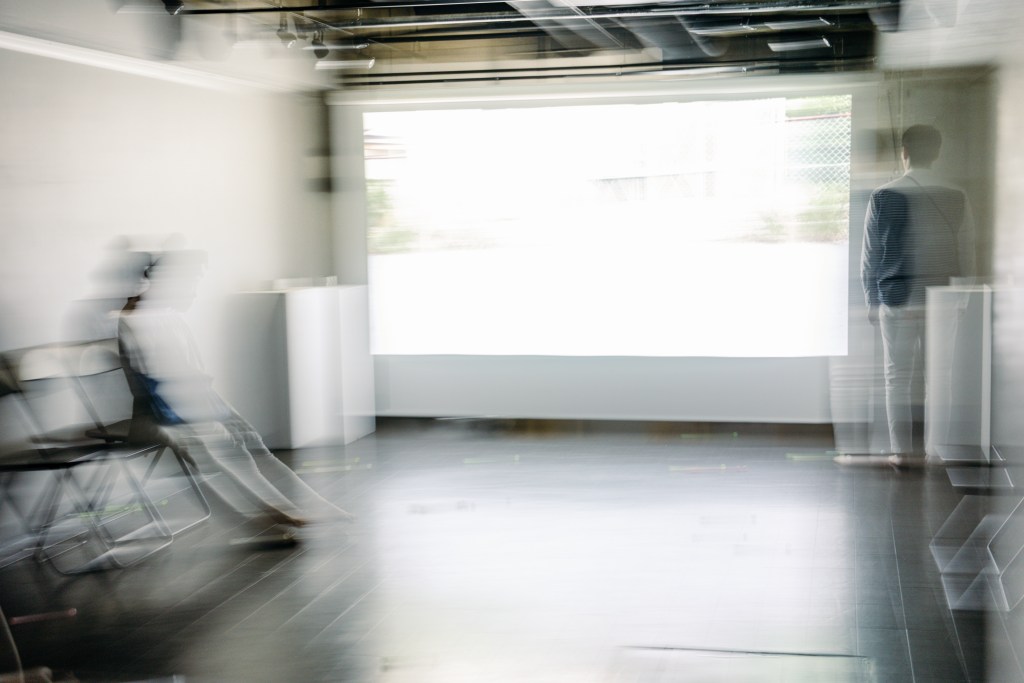


撮影:山田サトシ © 2025(Photo by YAMADA Satoshi
補遺
映像について
下記URL先のページで公開。
https://takahirokuroda-composer.com/?page_id=1112
壁・障壁、距離感についての補足——撮影映像を通して
箇条書きですが、プログラムノートに書ききれなかったことを記します:
・排除アートや排除ベンチと呼ばれるものは野宿者以外にも移動や行動に制限を与え、変容させます。この作品では取り扱いませんでしたが、ヘイトスピーチもマイノリティの移動や行動を委縮させ、強制的に変えさせます。
・仮放免者は就労禁止、国民健康保険の加入不可、生活保護の受給禁止といった、国連から人権侵害の疑いが濃いとして改善を促す勧告が出されているほどの状況に置かれていますが、その人権侵害の中には居住地以外の都道府県への移動や引っ越しには、事前に入管の許可申請が必要という移動制限もあります。申請のために東京都へ向かう際に渡る多摩川や荒川、江戸川はその人にとって壁・障壁に見えるかもしれません。
・日本在住の外国ルーツを持つ人たちは永住権を持っていても、経済的にも社会と関わり、納税していても帰化しない限りは政治参加ができません(住民投票に関しては一部の自治体は条例で外国人の投票権を認めています)。但し、納税していなかったとしても、権利は保障されるべきです。それは「国籍」や、あるいは別の属性によって左右されるものではありません。
・今回の制作で改めて痛感したことですが、少なくとも関東に住んでいると、アイヌモシㇼ/北海道や琉球/沖縄に住んでいる先住民の権利が毀損されている現実は、見えにくいです。沖縄料理屋や博物館での文化・芸術の「展示」などで部分的にアイヌモシㇼ/北海道や琉球/沖縄を知る機会はありますが、むしろそのことによって彼ら/彼女らが今置かれている現実はぼかされ、それに目を向けるきっかけが少なくなっているのではないかと感じました。オスプレイ配備撤回と米軍普天間飛行場の閉鎖・撤去のデモ行進をした際に、浴びせられた汚い言葉より、沿道の無関心さがショックであったという、その当時那覇市長だった翁長雄志のエピソードを思い起こしましたが、当時と現在、無関心さは変わっていないように思えます。在日米軍に関しても、首都圏において、横田や座間、横須賀、赤坂といった基地や施設周辺の住民にとっては緊要な問題ですが、そうでない人にとっては日常の中では意識されていないかもしれません。米軍基地・施設は国際法上では占領ではないとされますが、日本側の主権が制限されているので、実態としては占領的です。成田空港利用者も、なぜ羽田以外に空港を造る必要があったのか、その理由を知らない人が多いかもしれないです。
・朝鮮半島への植民地主義の痕跡は、実は首都圏にも数多く存在しています。朝鮮人労働者がインフラ整備に従事させられた歴史、関東大震災での朝鮮人・中国人虐殺の現場は、今も私たちの日常風景の中にあります。追悼碑がある場所もあれば、いまだ設置されない場所、そして近年撤去されてしまった場所さえあります。見えているのに見えない、あるいは見ないことにされている歴史がここにもあります。私たちはそうした記憶を宿す景色の中を歩いています。関東大震災での虐殺は、朝鮮人・中国人だけでなく、琉球出身者、そして福田村事件のように「朝鮮人」と誤認された部落出身者も犠牲となりました。これは単なる「誤認」ではなく、あらゆる「他者」への暴力が解き放たれた瞬間でした。
・壁・障壁や距離感を考えるにあたって、アパルトヘイト・ウォールの存在は常に頭の中にありました。それは、単に物理的に分断する壁だけではありません。移動を制限し、土地収奪し、生活を分断する制度的な壁であり、パレスチナ人の心に恐怖や絶望、無力感を植え付け、またイスラエル社会の多数派が壁の向こうのパレスチナ人への関心を持たないようにすることで、パレスチナ人の非人間化を促す心理的な壁であり、そしてそれを黙認する国際社会の沈黙という壁でもあります。パレスチナ人をガザ地区、西岸地区、イスラエル国内、そして周辺国の難民キャンプといった地域へと、さらには世界中に広がるディアスポラへと分断する包括的なシステム・象徴です。それへの考えを巡らせることは、朝鮮半島を分断し、そのコミュニティを分断している一因である日本の植民地主義・帝国主義の歴史に立ち返ることになり、加えて日本社会の中にある壁・障壁や距離感を再び直視することになります。
数字の台詞について
数字の台詞は、「障がい」を「持つ」とされる人が抑圧され、差別され、暴行を受け、殺戮された事件・事例、あるいはそれに関係する出来事の年号です。自分にとっては特に他人ごとではないと感じています。年号と事件・事例名(括弧内に国名もしくは地名)を以下に列記します:
・2016:相模原障害者施設殺傷事件(日本)
・1948:旧優生保護法の制定(日本)
・1933:遺伝病子孫防止法(ドイツ)
・1939:T4作戦(ドイツ)
・2016:Death of Abdirahman Abdi(カナダ)
・1922:アメリカの優生学者ハリー・ラフリン(Harry Hamilton Laughlin)が「モデル優生断種法」を考案(アメリカ合衆国)
・2025:Death of Victor Perez(アメリカ合衆国)
・2020:Killing of Eyad al-Hallaq(東エルサレム)
・2023:”Londonderry: Autistic boy punched and kicked in sectarian attack”( https://www.bbc.com/news/uk-northern-ireland-65763232、イギリス)
・1907:インディアナ州断種法の制定(アメリカ合衆国)
・2024:Killing of Mohammad Bhar(ガザ地区)
・1928:アルバータ州で性的不妊手術法が制定(カナダ)
・1936:エガス・モニスのロイトコミー手術(1935年)をウォルター・フリーマンが改良し、ロボトミー手術を開発(アメリカ合衆国)
・1983:宇都宮病院事件(日本)
・1977:第6回世界精神医学会議(WPA)「ハワイ宣言」を採択
当然ですが、上記のものが事件・事例、出来事のすべてではありません。必ずしも「障がい」だけが理由ではなく、レイシズムや宗教、占領、アパルトヘイト、植民地主義などの複合的な要素によるものもあります。それは見逃してはいけない、忘れてはならないことです。過去に終わったものだけではなく、今現在まで繰り返されていることです。
詩について
作品コンセプトに沿ってまず日本語での詩を作り、次いで英語版を作りました。全文を以下に載せます。
-日本語版-
わたしはいる
わたしは見る
放たれたもの
漂うもの
滲み出たもの
少しでも
通過する
わたしの中を
反射する
屈折する
流動する
揺らいでいる
重なり合う
わたしとわたし
立っている場所
通過する
目の前で
重なり合う
それらは見る
交差して
重なり合う
それとそれ
そこにいる
そこに在る
通過する
それらの中
-英語版-
there i am
here i see
things released
things adrift
things seeping
just a little
passing through
within me
reflecting
refracting
fluxing
swaying
overlapping
myself with myself
the place standing
passing through
before eyes
overlapping
here they see
intersecting
overlapping
each with each
being there
existing there
passing through
through them
「遠心的」かつ「求心的」な循環
コンセプトの起点の項で紹介した、モーデカイの論文におけるウォルコットの『Another Life』の分析の中で印象的な一節の一つが下記のものでした(日本語訳は私によるものです)。
Much of what these metaphors seem to be saying echoes Aimé Césaire’s notion of black culture as having an absorptive, accretive quality and recalls Senghor’s characterization of the movement of cognitive processes as circular — “centrifugal” and “centripetal.”
これらのメタファーが示唆していると思われることの多くは、黒人文化は吸収的かつ蓄積的な性質を持つというエメ・セゼールの考えと重なり、また、認知過程の動きを「遠心的」かつ「求心的」な循環として特徴づけたサンゴールの考えを想起させます。
[Pamela Mordecai, “‘A Crystal of Ambiguities’: Metaphors for Creativity and the Art of Writing in Derek Walcott’s Another Life,” World Literature Written in English, Volume 27, No. 1 (1987): p.103]
ここで書かれていることも、今回の作品に特に影響を与えています。
作品化できなかったことへの反省点
本作では、制作期間の制約や調査・研究の不足から、以下の視点への深い踏み込みが不足していたと自覚しています。
・階級格差の可視化:
労働者階級や非大卒者と、エリート・資本家・大企業・主要メディア・政治家、そして中産階級との間に横たわる情報・資源アクセスの不均衡、経済的・文化的な壁を、作品内で十分に扱えませんでした。この階級構造は、社会における他の多くの差別と深く結びついています。
・中道/リベラルの構造的加担:
「中道」「リベラル」とされる立場が無自覚のうちに、あるいは見て見ぬふりをすることで、差別構造や階級構造を維持・再生産している問題については、今回の表現には盛り込めていません。穏健さを装った発言が、いかにして現状を追認し、変革を阻む「見えない壁」として機能するのか。
・自己の二重的立ち位置:
アーティストとして経済的には不安定ながら、文化的・社会的資本を一定有している自らの曖昧な階級的位置――“境界を揺らす/維持する”両方の立場を同時に生きる自覚――を、言葉として明示できませんでした。
これらは、作品の主題である「複数性」や「プリズム的 -意識、 -ヴィジョン」のさらなる深化に不可欠な視点です。これらの視点の欠如、あるいは扱いきれなかった問題群を明記することで、次なる問いへの出発点としたいと思います。
1. Introduction
2. Point of Departure for the Concept
3. Structure of the Work
1. Actors’ Lines
2. Video
1. On the two layers of video
2. Types and intention of the first video layer
3. On my positionality
4. On the second video layer
3. Actions Using Super Balls
4. Closing
5. Notes
6. Appendix
1. About the video
2. Further notes on walls, barriers, and senses of distance—through the filmed footage
3. On the numerical lines
4. Poem
5. A “centrifugal” and “centripetal” circulation
6. Reflections on what could not be realized in the work
撮影:山田サトシ © 2025(Photo by YAMADA Satoshi)
Introduction
In creating this work, I was thinking about the multiple attributes I carry and about the walls, barriers, and senses of distance—both visible and invisible—that shape everyday life. My perspective and experience as an individual, together with the concept of pluralities, form the basis of this piece.
Point of Departure for the Concept
A starting point for the concept of this work was my encounter with the notion of “prismatic consciousness, prismatic vision,” proposed by the Jamaican writer, poet, and scholar Pamela Mordecai in her 1987 literary-critical essay “A Crystal of Ambiguities: Metaphors for Creativity and the Art of Writing in Derek Walcott’s Another Life,” an analysis of Derek Walcott’s autobiographical long poem Another Life. This notion is defined as “a tendency to perceive and interpret experience in a sometimes unresolved multiplicity,” describing a distinctive cognitive mode of people in the Caribbean region. It is characterized by:
・a mode of perception different from logical or linear modes of recognition;
・not dialectical;
・a way of perceiving that combines multi-facetedness with inclusiveness.
This is rooted in the historical background in which people forcibly taken from Africa as enslaved persons, and their descendants, while compelled to accept the culture and language of those who dominated them, preserved their own languages, customs, and beliefs and—through mixture (creolization*)—built new communities and identities. Tohru Nakamura, a scholar of Caribbean literature and thought, explains this notion in his book 『私が諸島である カリブ海思想入門』 [I Am an Archipelago: An Introduction to Caribbean Thought] (2023, Shoshi Kankan Bō) as “a diverse consciousness that enables people with different cultural and racial backgrounds in the Caribbean to endure the shock of encountering one another through the process of creolization and to transform themselves into a new community.”
Because I was born and raised in Japan, it is impossible for me to fully understand the experiences of people living on the Caribbean islands, and I cannot adopt Mordecai’s concept—rooted as it is in Caribbean literature and postcolonialism—as it stands. Nonetheless, this concept resonated with experiences I had likely been feeling, perhaps unconsciously. Encountering it gave me the sense that my ways of recognizing my own experiences and positionality had been rebuilt. From there, the concept of this work gradually took shape. I seek expression by overlaying this concept onto my own experiences and the multiple attributes I carry. This work proceeds on the premise of paying respect to the original thought and not downplaying its political and cultural background.
Structure of the Work
The piece consists of three layers:
・Actors’ lines (which itself contains two sub-layers);
・Video (which itself contains two sub-layers);
・Actions using super balls (small, highly bouncy rubber balls—both phosphorescent/glow-in-the-dark and ordinary non-glowing ones).
Actors’ Lines
The first layer of the actors’ lines draws on my experience as a neurodivergent person (a person whose brain and nervous-system functioning departs from the socially defined standards and norms of what is considered “normal”). One actor takes the role of a neurotypical person (whose brain and nervous-system functioning falls within those socially defined standards and norms), while the other takes a role closer to my own as a neurodivergent person; these roles switch depending on the scene. In the past, I found it difficult to speak (especially to make small talk): I did not know what to say to someone, and while there were questions I could answer well enough, there were others I could not (more often, I could not). (I consider myself somewhat better at this now than before.) Short, fragmentary scenes of such conversations unfold in succession. Note that this represents only one facet of my own neurodivergence**; there are, of course, other facets. I myself am AS(D), but because this is based strictly on my own experience, please do not generalize it as “this is what AS(D) people are like” or as “this is what all neurodivergent people are like.”
The second layer of the actors’ lines consists of numbers. Details are provided in the Appendix.
Video
On the two layers of video
When video from the first layer is projected, the first layer of actors’ lines described above is spoken. When video from the second layer is projected, the second layer of lines is spoken, and actions using super balls are also performed.
Types and intention of the first video layer
The first video layer largely consists of footage showing walls, fences, and rivers, though it also includes images that do not depict these. These images include ones that express the walls and distances I feel toward the majority from my position as someone with minority attributes, and ones that express the walls, barriers, and distances perceived and felt by minorities and marginalized people in Japan toward the majority attributes I carry. Some are visible; others are invisible. There are walls and distances that exist institutionally or legally, and others that have been produced through urban development or administration. Some are also entangled with the history of Japan’s imperialism and colonialism grounded in the emperor system. Such walls, barriers, and distances are connected to oppression, discrimination, exclusion, and massacre.
On my positionality
As a neurodivergent person, I am a minority in Japan, and at the same time I carry many majority attributes. As someone positioned within the majority, I am also on the side that structurally, institutionally, and normatively oppresses, discriminates against, and excludes minorities and marginalized people—for example, Ryukyuan people, Ainu people, Zainichi Koreans, foreign residents in Japan, women, sexual minorities, people understood to “have” disabilities (different from mine), older adults, and unhoused people. In addition, I have privileges I enjoy by virtue of living in the Tokyo metropolitan area.
For that very reason, I clearly oppose all discrimination, all xenophobia, and all imperialism and colonialism. I refuse to stand on the side of perpetration within structural discrimination, and I seek a world in which everyone’s human rights are guaranteed and people can live as equals. I do not consider this a mere ideal; I consider it a reality that must be pursued through daily practice.
If Mordecai’s concept—an important point of departure for this work—is reduced to something purely aesthetic, there is a risk that its political force will be bleached out. For that reason, it was necessary to touch upon structural discrimination in Japan (xenophobia; the history and present of imperialism and colonialism). Regarding filming, anything I judged to be ethically problematic, to risk outing someone, or to possibly endanger those involved by being shown was excluded in advance.
On the second video layer
The second video layer is mostly a completely black screen. Occasionally, however, a single line from a poem I wrote in keeping with the concept of the work appears on screen. A Japanese line and an English line appear with a slight overlap of text, but one of the two is displayed more faintly. The full poem is included in the Appendix.
Actions Using Super Balls
The super balls express that I carry multiple attributes (some I am aware of, others I may not be) and that society and the world include people with multiple attributes (some publicly recognized, others not). In addition, the actors’ actions with super balls explore the possibility of non-verbal responses to the difficulty of linguistic communication expressed in the spoken lines.
Closing
This work deliberately foregoes any imposed narrative structure. There is no introduction–development–turn–conclusion. Multiple realities, filtered through the multiple attributes within me, are presented through various layers. That is all. That is my everyday life as it is—from where I am and what I see.
In the essay introduced above, Mordecai writes: “This ability to realize the diverse ‘other’ is precisely what prismatic perception inclusively embraces.” I hope that recognizing and living pluralities can be a force for imagining and creating a world liberated from all oppression and discrimination.
In that process, we must constantly re-examine what kinds of structures we are involved in and what we are sustaining. Governments, corporations, cultural institutions, and individuals—all bear both the responsibility and the capacity to make a better world. I would be glad if this work could serve as a small occasion for such re-examination.
Notes
* According to Nakamura’s 『私が諸島である カリブ海思想入門』 [I Am an Archipelago: An Introduction to Caribbean Thought], this concept is one that Caribbean thinkers such as Derek Walcott (a poet and playwright from Saint Lucia) and Édouard Glissant (a writer, poet, philosopher, and literary critic from Martinique) relied upon in order to grasp the racial and cultural mixture born from colonial rule as decisive to their own subjectivity and agency, out of critique of and reflection on the essentialism of Négritude. Nakamura’s book also introduces the idea of the Barbadian historian and poet Kamau Brathwaite that creolization in the Caribbean consists of two processes of change: “acculturation” and “interculturation.” In Nakamura’s account, “acculturation” refers to a one-directional power relation between cultures in which a dominant culture absorbs others, while “interculturation” refers to a relation without domination and subordination, in which both sides mutually influence one another and create a rich cultural soil.
** “Neurodivergence” refers to the state of being neurodivergent. It includes not only congenital examples such as AS(D), ADH(D), dyslexia, dyspraxia, and dyscalculia, but also instances arising through experience—for example, changes in brain function caused by trauma, long-term meditation practice, or frequent use of psychedelics.
References:
https://neuroqueer.com/neurodiversity-terms-and-definitions/
https://www.health.harvard.edu/blog/what-is-neurodiversity-202111232645
https://www.helpguide.org/mental-health/wellbeing/being-neurodivergent
撮影:山田サトシ © 2025(Photo by YAMADA Satoshi
Appendix
About the video
Available at the page below.
https://takahirokuroda-composer.com/?page_id=1112
Further notes on walls, barriers, and senses of distance—through the filmed footage
These are offered in brief, as points I could not fully include in the main program note:
・What is called “hostile architecture” or “hostile benches” restricts and reshapes the movement and behavior not only of unhoused people but also of others. Although this work does not treat it directly, hate speech also intimidates and constrains the movement and behavior of minorities, forcing change upon them.
・People on provisional release from immigration detention (kari-hōmen) are placed in conditions so severe that the United Nations has issued recommendations urging improvement on the grounds of likely serious human-rights violations—including bans on employment, inability to enroll in the national health insurance system, and exclusion from public assistance. Among these human-rights violations is a mobility restriction requiring prior approval from immigration authorities to travel to or relocate to prefectures other than one’s registered place of residence. For someone who must travel to Tokyo to file an application, rivers such as the Tama, Arakawa, and Edo may appear as walls or barriers.
・People with foreign roots living in Japan, even if they hold permanent residency, participate economically and socially, and pay taxes, cannot participate politically unless they naturalize (some municipalities, however, grant voting rights to non-citizens for certain local referenda by ordinance). That said, rights should be guaranteed regardless of tax status. They should not depend on “nationality” or on any other attribute.
・This production made me acutely feel once again that—at least when living in the Kantō region—the reality that the rights of Indigenous peoples living in Ainu Mosir / Hokkaidō and in Ryukyu / Okinawa are being undermined is difficult to see. There are partial opportunities to learn about Ainu Mosir / Hokkaidō and Ryukyu / Okinawa through Okinawan restaurants or cultural and artistic “exhibitions” in museums; yet I felt that such encounters may also blur the realities in which people are currently placed, reducing occasions to confront them. I was reminded of an episode in which Takeshi Onaga (then mayor of Naha) said that during a demonstration march calling for the withdrawal of the Osprey deployment and the closure and removal of U.S. Marine Corps Air Station Futenma, what shocked him more than the abusive words hurled at them was the indifference of onlookers. It seems to me that this indifference has not changed. Regarding U.S. forces in Japan, in the Tokyo metropolitan area it is an urgent issue for residents around bases and facilities (e.g., Yokota, Zama, Yokosuka, Akasaka), but for others it may not be consciously present in daily life. U.S. bases and facilities are not classified as occupation under international law, but because Japan’s sovereignty is constrained, the reality is effectively occupation-like. Many users of Narita Airport may not know why it was deemed necessary to build an airport other than Haneda.
・Traces of colonialism on the Korean Peninsula in fact exist throughout the Tokyo metropolitan area as well. The history of Korean laborers forced into infrastructure construction and the sites of the massacres of Koreans and Chinese following the Great Kantō Earthquake of 1923 still exist within our everyday landscapes. Some places have memorials; others still have none; and some have even been removed in recent years. There are histories that are visible yet unseen—or made not to be seen—here as well. We walk through landscapes that hold such memories. The massacres during the Great Kantō Earthquake claimed victims not only among Koreans and Chinese but also among people from Ryukyu and among Buraku people who were misidentified as “Koreans,” as in the Fukuda Village Incident. This was not merely “mistaken identity” but a moment in which violence against every “other” was unleashed.
・In thinking about walls, barriers, and senses of distance, the apartheid wall was always in my mind. It is not merely a physical wall of separation. It is an institutional wall that restricts movement, dispossesses land, and fractures life; a psychological wall that instills fear, despair, and helplessness in Palestinians while encouraging the majority in Israeli society to have no interest in Palestinians on the other side, thus promoting their dehumanization; and also a wall of silence in the international community that condones it. It is a comprehensive system and symbol that fragments Palestinians into Gaza, the West Bank, within Israel, refugee camps in neighboring countries, and further into a diaspora spread across the world. To think this through leads back to the history of Japanese colonialism and imperialism—one factor in the division of the Korean Peninsula and its communities—and also compels a renewed confrontation with the walls, barriers, and senses of distance within Japanese society.
On the numerical lines
The numerical lines are years connected to incidents or cases in which people understood to “have” disabilities were oppressed, discriminated against, assaulted, or killed—or to events related to such incidents. For me, they do not feel distant or unrelated. The years and the names of the incidents or cases (with country or place in parentheses) are as follows:
・2016: Sagamihara stabbings at a care facility (Japan)
・1948: Enactment of the former Eugenic Protection Law (Japan)
・1933: Law for the Prevention of Offspring with Hereditary Diseases (Germany)
・1939: Aktion T4 (Germany)
・2016: Death of Abdirahman Abdi (Canada)
・1922: U.S. eugenicist Harry Hamilton Laughlin devises a “Model Eugenical Sterilization Law” (United States)
・2025: Death of Victor Perez (United States)
・2020: Killing of Eyad al-Hallaq (East Jerusalem)
・2023: “Londonderry: Autistic boy punched and kicked in sectarian attack” (https://www.bbc.com/news/uk-northern-ireland-65763232, United Kingdom)
・1907: Indiana sterilization law enacted (United States)
・2024: Killing of Mohammad Bhar (Gaza Strip)
・1928: Sexual Sterilization Act enacted in Alberta (Canada)
・1936: Walter Jackson Freeman II refines Egas Moniz’s leucotomy (1935) and develops lobotomy surgery (United States)
・1983: Utsunomiya Hospital Incident (Japan)
・1977: Adoption of the “Declaration of Hawaii” at the 6th World Psychiatric Association (WPA) Congress
Needless to say, the above does not exhaust all incidents, cases, or events. They are not necessarily about disability alone; they can also involve intersecting factors such as racism, religion, occupation, apartheid, and colonialism. This is something we must not overlook or forget. It is not only something that ended in the past but something that continues to be repeated up to the present.
Poem
In keeping with the concept of the work, I first wrote the poem in Japanese and then made an English version. The full text is as follows.
-Japanese version-
わたしはいる
わたしは見る
放たれたもの
漂うもの
滲み出たもの
少しでも
通過する
わたしの中を
反射する
屈折する
流動する
揺らいでいる
重なり合う
わたしとわたし
立っている場所
通過する
目の前で
重なり合う
それらは見る
交差して
重なり合う
それとそれ
そこにいる
そこに在る
通過する
それらの中
-English version-
there i am
here i see
things released
things adrift
things seeping
just a little
passing through
within me
reflecting
refracting
fluxing
swaying
overlapping
myself with myself
the place standing
passing through
before eyes
overlapping
here they see
intersecting
overlapping
each with each
being there
existing there
passing through
through them
A “centrifugal” and “centripetal” circulation
One passage that particularly struck me in Mordecai’s analysis of Walcott’s Another Life (introduced above) is the following (the Japanese translation is mine):
Much of what these metaphors seem to be saying echoes Aimé Césaire’s notion of black culture as having an absorptive, accretive quality and recalls Senghor’s characterization of the movement of cognitive processes as circular — “centrifugal” and “centripetal.”
[Pamela Mordecai, “‘A Crystal of Ambiguities’: Metaphors for Creativity and the Art of Writing in Derek Walcott’s Another Life,” World Literature Written in English, Volume 27, No. 1 (1987): p.103]
What is written here has also had a particularly strong influence on this work.
Reflections on what could not be realized in the work
In this work, due to constraints in the production period and shortcomings in my research, I am aware that I could not delve deeply enough into the following perspectives:
・Making class disparities visible:
I could not sufficiently address, within the work, the imbalance of access to information and resources—and the economic and cultural walls—between the working class and those without university degrees on one side, and elites, capitalists, major corporations, major media, politicians, and the middle class on the other. This class structure is deeply intertwined with many other forms of discrimination in society.
・Structural complicity of the “centrist” / “liberal”:
I could not incorporate, within this expression, the problem that positions labeled “centrist” or “liberal” maintain and reproduce discriminatory and class structures—whether unconsciously or through willful disregard. How does discourse that performs moderation function as an “invisible wall” that affirms the status quo and blocks transformation?
・My own dual positionality:
While economically unstable as an artist, I nonetheless hold a certain amount of cultural and social capital. I could not clearly articulate in words my ambiguous class position—an awareness of living, at once, on both the side that “shakes” and the side that “maintains” boundaries.
These perspectives are indispensable for further deepening the work’s themes of “pluralities” and “prismatic consciousness, prismatic vision.” By explicitly stating what was missing or what I could not fully address, I wish to take this as a point of departure for the next set of questions.

撮影:山田サトシ © 2025(Photo by YAMADA Satoshi)
 Takahiro Kuroda